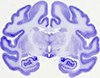
There were no significant behaviorally driven changes in ACh efflux in RSC area 30. 

The present study of the connections of the STG with medial paralimbic cortex showed that the caudal part of the STG (area Tpt and caudal area paAlt) and adjacent cortex of the upper bank of the superior temporal sulcus (caudal area TPO) have reciprocal connections with the caudal cingulate gyrus (areas 23a, b and c), retrosplenial cortex (area 30), and area 31.
Finally, a dysgranular transition zone includes both area 23d and retrosplenial area 30.
There is a stepwise laminar differentiation starting from retrosplenial area 30 towards the isocortical regions of the medial parietal cortex. This includes a gradational emphasis on supragranular laminar organization and general reduction of the infragranular neurons as one proceeds from area 30 toward the medial parietal regions, including areas 3, 1, 2, 5, 31, and the supplementary sensory area (SSA).
Pro-a has an incipient layer IV, contains few SMI-32+ neurons, and adjoins area 30 dorsally.
Histologic studies of retrosplenial areas 29 and 30 identify them on the ventral bank of the cingulate gyrus (CGv), whereas standardized atlases show area 30 on the surface of the caudomedial region. area 30 is dysgranular with a variable thickness layer IV that is interrupted by large NFP-ir neurons in layers IIIc and Va. Although area 30 does not appear on the surface of the caudomedial lobule, a terminal branch can form less that 1% of this gyrus.
The present analysis revealed that, as is the case in the macaque brain, the human retrosplenial cortex is composed of granular areas 29a-c and d, and dysgranular/agranular area 30.
Injections of anterograde and retrograde tracers confined to retrosplenial area 30 revealed that this area has reciprocal connections with adjacent areas 23, 19 and PGm, with the mid-dorsolateral part of the prefrontal cortex (areas 9, 9/46 and 46), with multimodal area TPO in the superior temporal sulcus, as well as the posterior parahippocampal cortex, the presubiculum and the entorhinal cortex. The connectivity of area 30 suggests that it may play a role in working memory processes subserved by the mid-dorsolateral frontal cortex in interaction with the hippocampal system..
It was demonstrated that the mid-dorsolateral frontal cortex (areas 46, 9/46, and 9) and its medial extension (medial areas 9 and 9/32) is the origin of a specific fiber pathway, running posteriorly as part of the cingulum bundle, and terminating mainly in the retrosplenial area 30 and the posterior presubiculum.
Posterior cingulate cortex has medial and lateral parts of area 29, a dysgranular area 30, and three divisions of area 23: area 23a has a thin layer IIIc and moderate-sized pyramids in layer Va, area 23b has large and prominent pyramids in layers IIIc and Va, and area 23c has the thinnest layers V and VI in cingulate cortex.
This increase became more marked with the progression of neuronal death and was still evident in the same area 30 days later.
In 64% of all DAT cases there was a progressive shift in NFT from ventral area 30 where most were in layer II to areas 23a--b where there was a balance between those in superficial and deep layers to dorsal area 23c where most were in layers V and VI..
Area 29a-c received inputs from area 46 of the frontal lobe and the subiculum and in turn it projected to area 30. area 30 had afferents from the posterior parietal cortex (area Opt) and temporal area TF.
area 30 has a dysgranular layer IV.
-
[ View All ]